A year ago I switched from ChatGPT to Claude. I’d taught ChatGPT my preferences for a year — pull-request style, the right tone for emails to my accountant, what “the vendor” means in our shared context. None of it moved. I started over.
Last month I did it again, on purpose, as a test. I switched from Claude to Gemini for a week — the desktop one, my primary daily assistant. The point was not to compare the assistants. The point was to find out whether anything I’d built on top of Mneme cared.
It didn’t. This post is about why.
How I switched from Claude to Gemini
Setup is short. I had Mneme connected to Claude Desktop already — about eight months of notes, lab results, contracts, a few hundred saved memories ranging from “my new accountant is Sarah at Lakeside” to “PostHog dashboards expect snake_case event names.” Real working corpus.
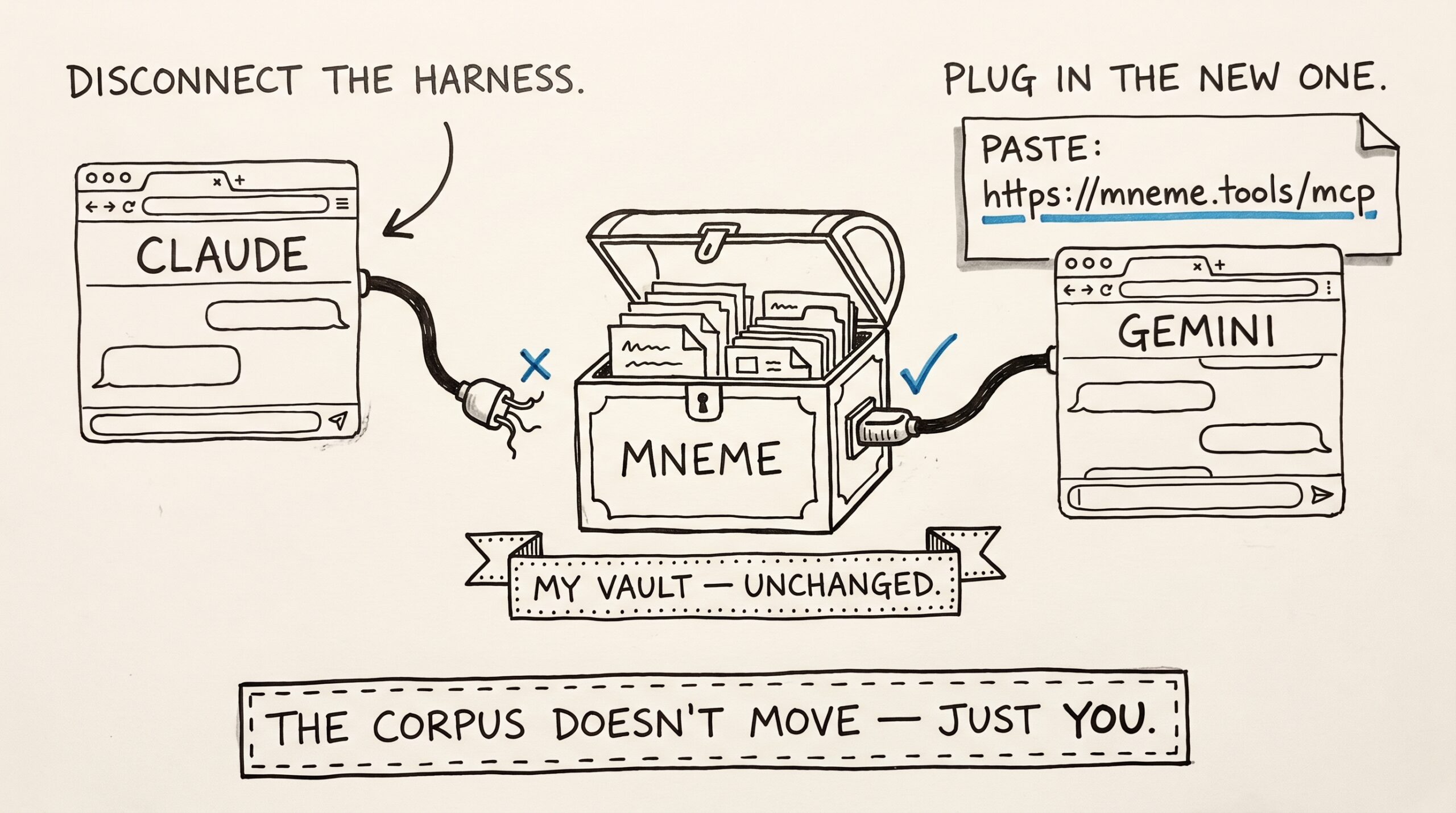
I disconnected Claude Desktop from Mneme — not the corpus, just the harness. The vault doesn’t move. It sits where it has always sat, in my account.
Then I opened the Gemini CLI, told it to add a new MCP-compatible service, and pasted in the MCP connector URL from my Mneme Settings page (https://mneme.tools/mcp). One email confirmation later, Gemini was talking to my vault. Total elapsed time: about ninety seconds.
Then I worked normally for a week.
The connect-an-AI moment is one click and an email
The thing I expected to be the hardest was a single button-press. The harness asks for a connector URL. You paste yours. Mneme emails you a confirmation link. You click it. Done.
What’s happening underneath is that the new assistant just earned permission to read and write your vault, with the same scope as Claude or any other assistant you’ve already approved. Different harness, same corpus, no second account, no second login.
If you ever want to revoke a harness, the Activity log shows every read and write that came from each one — and revocation is one click in the same place. Connecting an AI is cheap; disconnecting is also cheap. That’s the design.
Day one: the things I expected to lose
I expected the bumps.
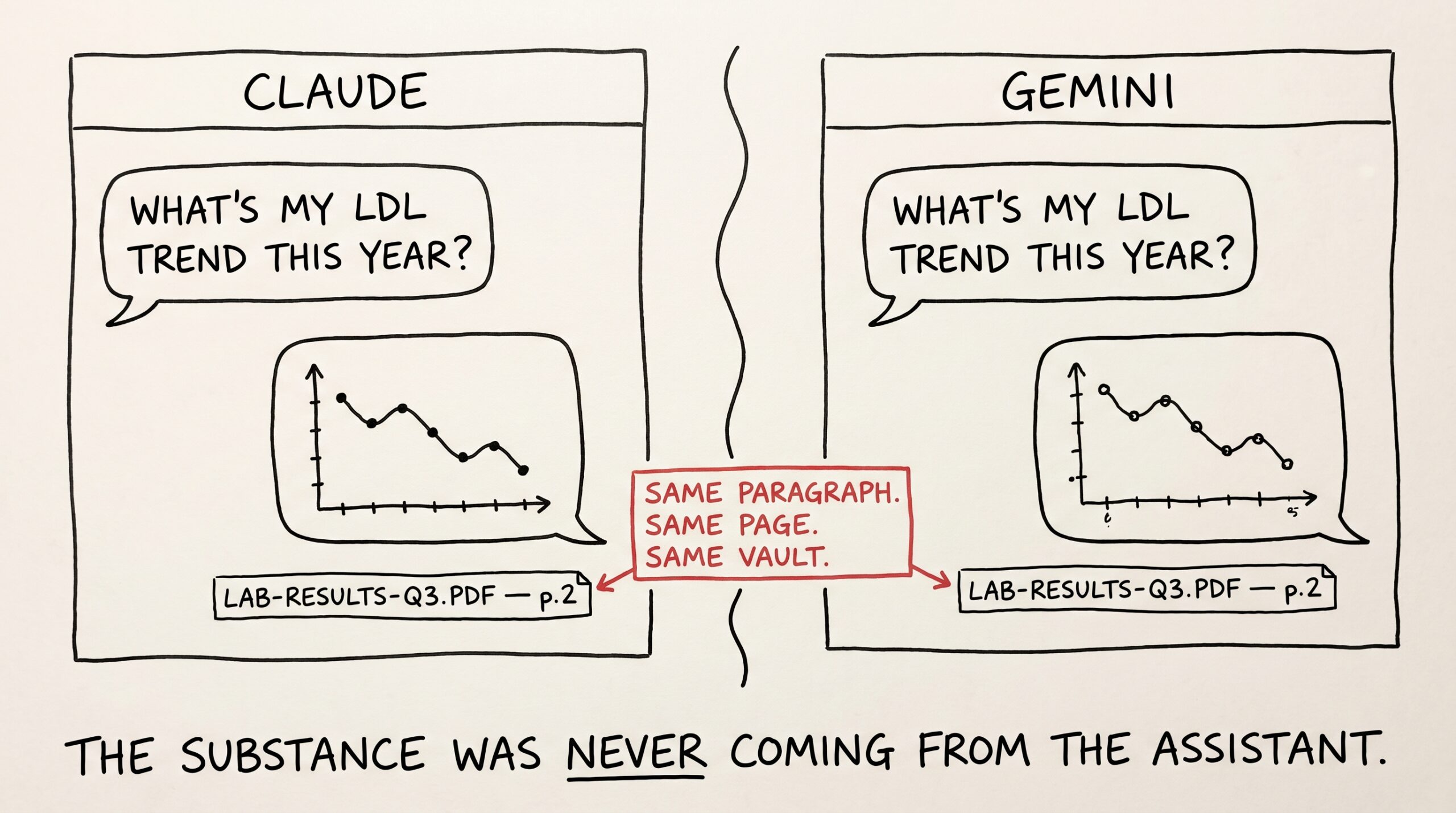
I asked Gemini, “what was the last thing I noted about the Foundry contract?” — the kind of question I’d been asking Claude for months. Gemini went looking through my vault and came back with the same paragraphs. I asked, “what’s my LDL trend this year?” — same kind of cross-document question, four ingested lab PDFs deep. Same answer, same page anchors.
The chat felt different. Gemini phrases things differently than Claude. Different markdown habits, different tendencies on length. But the substance was identical because the substance was never coming from the assistant. It was coming from a vault that didn’t move.
The two things I half-expected to break didn’t break either:
- Long context. When I asked a synthesis question that pulled six excerpts back, Gemini composed them about as well as Claude does. The recall was the hard part; the composition is what these models are for.
- My saved memories. Things I’d told Claude — “remember that PostHog dashboards expect snake_case” — were still there, and they surfaced in Gemini’s recall the same way.
The thing I did lose was the chat sidebar in Claude with its threaded history. That’s a Claude feature, not a memory. It was actually clarifying — I noticed how often I’d been treating that sidebar as memory when it isn’t.
Day three: the workflow I stopped thinking about
By day three, the experiment stopped feeling like an experiment.
I added a new PDF — a bid from a contractor — by handing it to Gemini and saying “add this to Mneme.” Two days later I asked Claude (which I’d reconnected for a quick comparison) about it. The PDF was there. Of course it was. There’s only one vault.
I caught myself thinking: if a better assistant comes out next month, I move in 90 seconds. Not the corpus — the corpus doesn’t move. Just me. The cost of switching has collapsed.
This is the actual thing portable memory buys. It’s not a one-time win during a migration. It’s the permanent reduction in switching cost across every future decision you make about which AI to use.
What this means for the rest of your stack
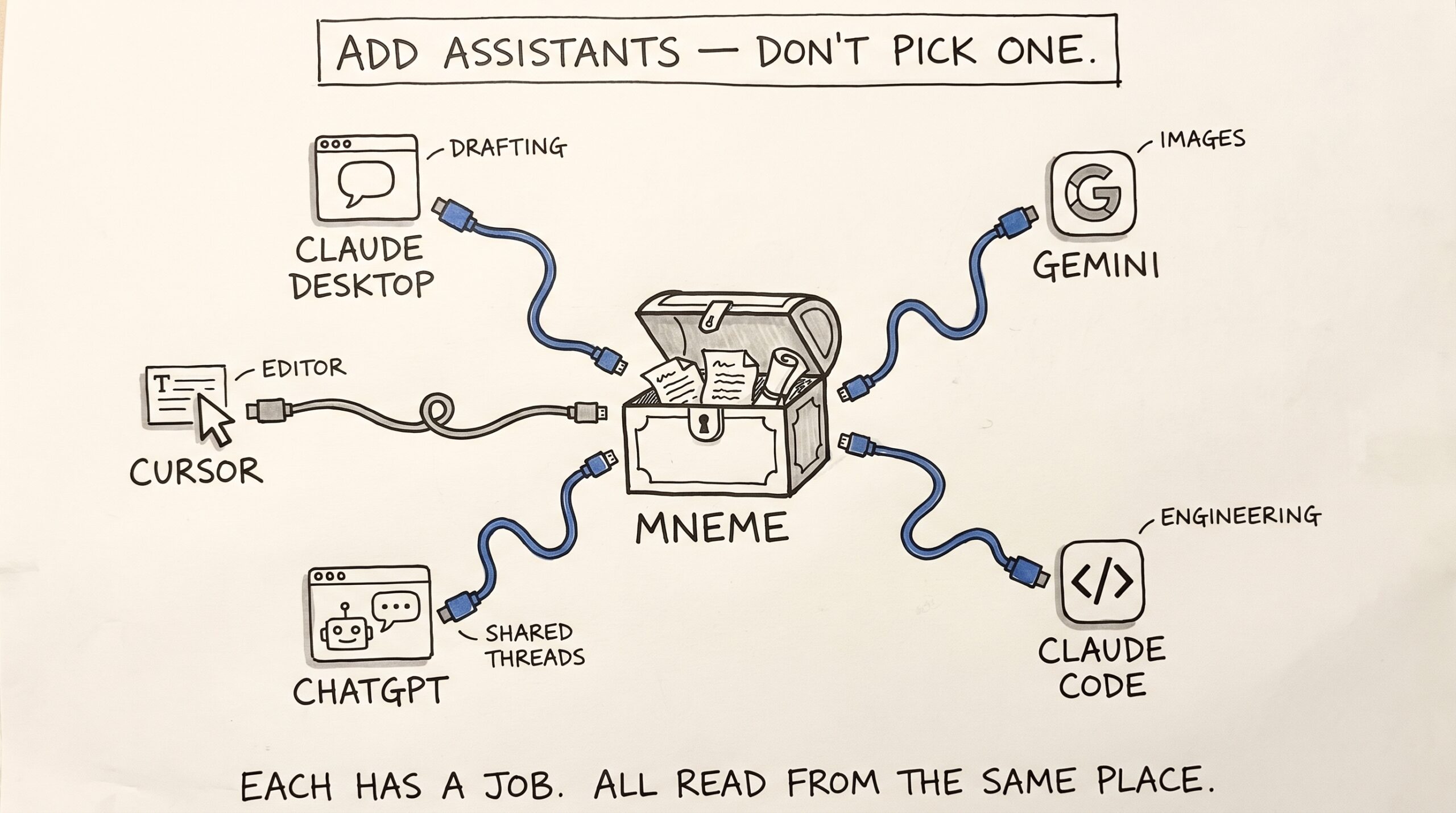
A small consequence I didn’t appreciate going in: it changes how you think about adding assistants instead of switching between them.
Claude is excellent at long-form writing. Gemini is fast and well-integrated for image work. ChatGPT is where some of my coworkers send links. Cursor lives in my editor. There’s no obvious reason to pick one as the “primary” anymore. Each has a job. They all read from the same place.
What I do now: Claude Desktop for drafting, Gemini for image-heavy tasks (it’s good at reading screenshots), Claude Code for engineering work, and ChatGPT only when somebody else opened a thread there. They all see my vault. They all save to the same memories. The boundary between assistants stopped mattering.
If you’ve been waiting to “settle on one AI,” the conclusion of the experiment is: don’t bother. The decision is smaller than you think it is.
Things Mneme will be honest about
Adding a new harness is a one-time hassle, not a daily one. Each time you connect a new assistant, you click through the email confirmation. After that, the connection is silent and stays put. If you reset your devices, you’ll redo it once. That’s it.
If the new harness has its own native memory features (chat history, “projects,” etc.), you’ll have two places memory could live for a while — the harness-native one, and Mneme. The recommendation is to lean on Mneme as the source of truth and ignore the harness-native slot, otherwise you slip back into the failure mode from the first post: hostage memory in a new chatbot.
The vault is owned by one user today. If two people in your household want to share family memories, that’s not a configuration; it’s a feature that isn’t built yet. Workspaces are next.
What I’d suggest
If you’ve been a one-assistant person for a while, the cheapest way to feel this is to install one other MCP-compatible assistant this weekend, paste your MCP connector URL into it, and use it for one workday. You don’t have to switch permanently. You just have to feel the absence of the migration cost. After that, the case writes itself.
The next post in the series is about the smallest behavior that compounds the most: the “remember that…” habit that makes every future AI conversation smarter.
Or start your vault and run the same experiment on your own corpus.
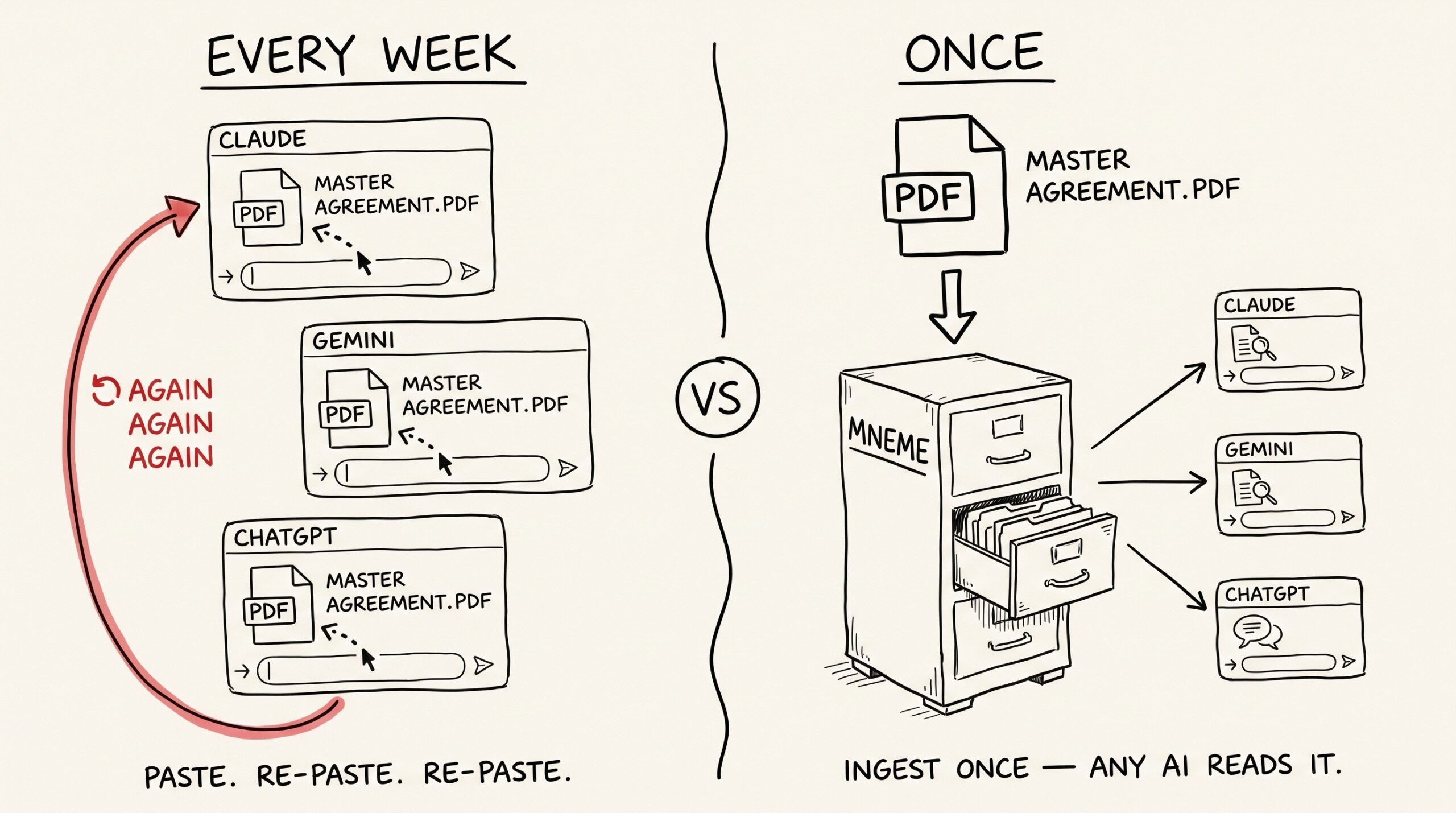
Stop pasting PDFs into Claude — give every assistant permanent access to your documents
You've pasted the same twelve-page master services agreement into three different chats this month. Once for the indemnification clause. Once for a question about IP assignment. Once because you forgot…
The ‘remember that…’ habit that makes every future AI conversation smarter
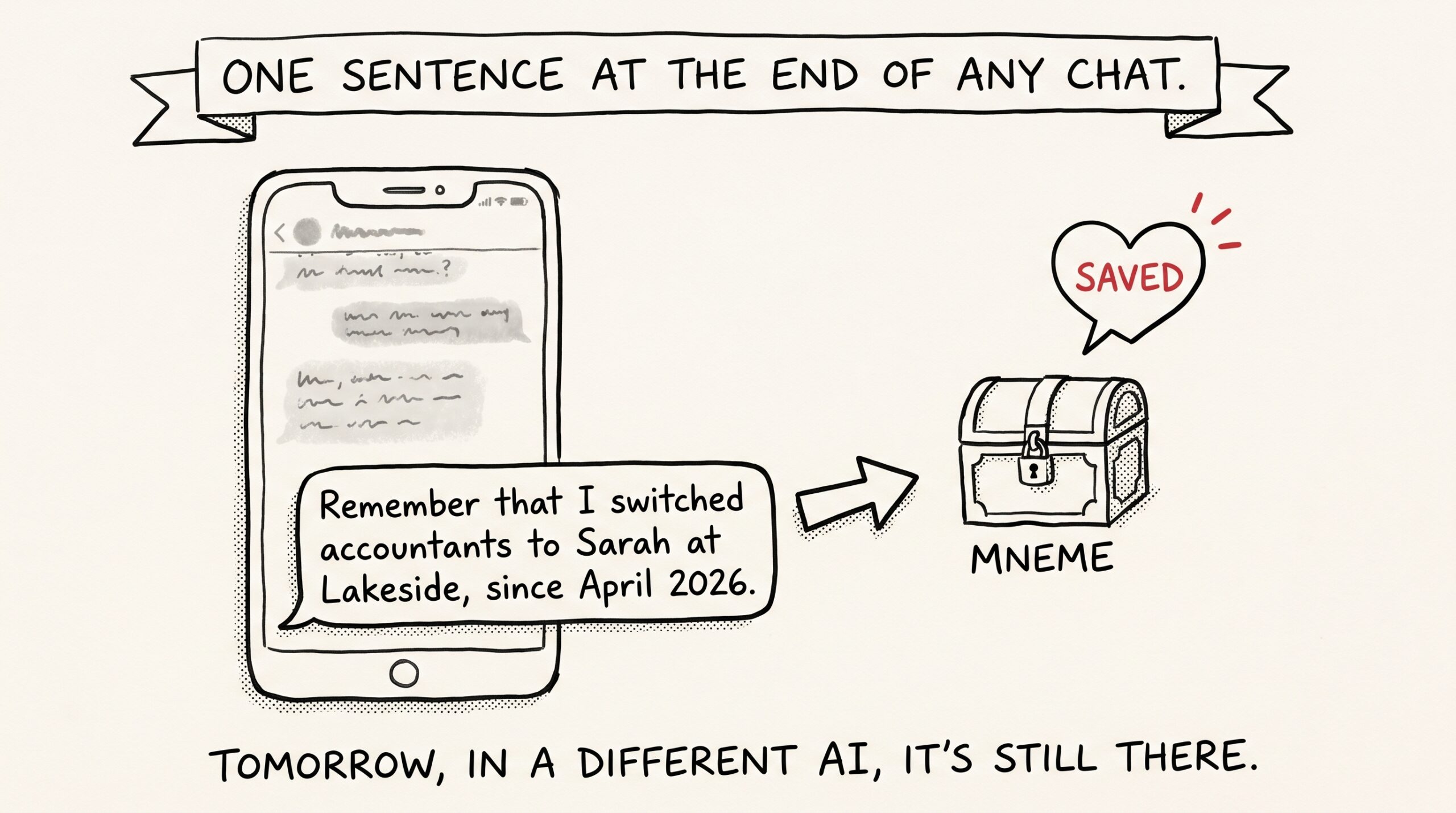
The smallest behavior change that makes every future AI conversation smarter is also the laziest one. You add one sentence to the end of a chat. You don't think about…